Showing posts with label Green. Show all posts

Friday, September 28, 2012

Spring and Summer Electricity Bills with Solar Power

From my last post, I indicated that one of my recent electricity bills was really low ($16), but I didn't delve into the bill details.  What I'd like to do in this post is share a bit about those bill details and the elements that comprise a typical electricity rate plan for solar power owners here in Texas.

On that note, I logged into my account online and took a screenshot of the "current electricity details" portion of my March 2012 bill (my rep is Reliant, could this information may be called something similar with TXU or Green Mountain statements).

The first thing to notice is the "29 day billing period". Why is this not simply the first day of the month to the last day of the month?  Most likely because my old analog electricity meter required someone to physically come and read the meter values for billing purposes.  My premise (home) was probably lumped together with other homes in my area into a "billing cycle", while taking into account weekends and holidays, and given the dates of 3/6/2012 to 4/4/2012 so that the meter reader could more conveniently read as many meters as possible.

Of course, with the new smart meters, I'm guessing it's really not necessary to have the billing cycle fall on these predetermined dates since a meter reader person is no longer necessary.  However, it's probably more of a legacy billing system and business process holdover for utilities to do it this way.

In the future, as utilities' IT systems mature, I'd hope that they would allow customers to choose the dates for each month's billing cycle since one of the advantages of smart meters is the granularity of the data (15 minutes, so daily sums are easily possible).

At left are more screenshots, including portions of my April and May electricity bills.

Again, notice the billing days each time.  My April bill shows 4/4/2012 to 5/4/2012, while my May bill shows 5/4/2012 to 6/5/2012.  Interestingly, the date of 5/4/2012 shows up in both statements, so which one is correct?

What is missing here are the times on those dates for which meter readings are included.  My best guess is that "start date" is inclusive of all hours on that day, while the "end date" is exclusive of that day's hours (meaning midnight).  In other words, my April bill would go from 12:00am on 4/4/2012 to 12:00am on 5/4/2012.  What do you think?

At right are a few more screenshots, this time from my Summer electricity bills.

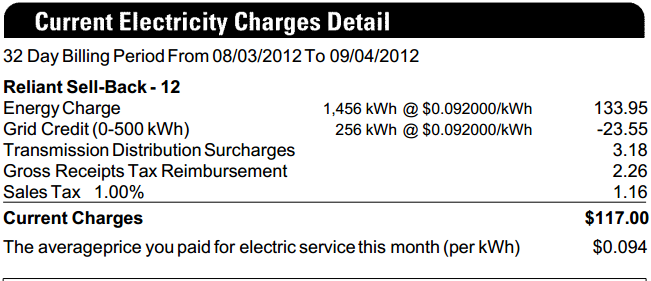
The next line items to notice are the Energy Charge (which I explained briefly here) and the Grid Credit (which is touched on here).

My rate is the same in each bill (meaning it's a fixed rate) and the usage was steadily increasing from March through May (551 kWh to 946 kWh consumed).  This indicates that it was getting warmer and my A/C was in use a bit more each month.  Since we us natural gas in my home for heating, I expect this trend to reverse once the Fall months come around.

Also, notice that the rate for Grid Credit was the same as the Energy Charge ($0.092 per kWh).  This is the great thing about have a rate plan that pays me back for excess solar power placed back onto the grid.

Interestingly, since I know that my solar panel system produces at least 800 kWh in the Spring/Summer months, I can simply subtract the Grid Credit kWh number from the amount of energy I produced in that month to figure out how much of my solar production I consumed that same month.

So it's apparent that I'm saving some money each month with solar power, but what's the difference compared to last year?  Glad that I asked!

At left is one final screenshot, from my August bill, of the "electricity usage summary" section.

The difference between August 2011 and August 2012 was about 1400 kWh, about 50% less.  Since solar power provided about 600 kWh of my total consumption, my bill without solar would have showed about 2000 kWh sans solar power.  Then, where's the 800 kWh difference coming from?

One potential culprit is the Billing Days line item.  However, last year my August billing cycle had fewer days than the same period this year, so that should have led to a smaller difference.

Another factor could have been that we were more diligent in watching our electricity use, such as turning off various electronics when not in use and turning up the thermostats another degree (while using ceiling fans instead).  This would probably have a measurable effect on energy savings, although it would take some effort to determine the exact amount (time to finally plug in my home energy monitor!).

One last factor to consider is the average high temperature in the billing period.  Last year in August, Texas had it's worst heat wave ever, with average highs measured at 104 degrees F.  However, this year has been much tamer, with average highs around 97 degrees F.  I believe this is the primary reason for the 800 kWh difference between August last year and this year.

Anyways, I hope this provided some useful insights into the billing aspects that a solar energy home owner sees these days.  Please feel free to post any questions and I'll try to get back to you sooner than my recent post history would indicate...

Thursday, April 26, 2012

We got Solar Power for our home! But, what's the ROI payback?

View of our solar panels from the alley
Yes, that's right.  Solar panels, on our roof, just in time for summer!

I'm really excited about the benefits (primarily to save money), but our setup was only made possible, financially, due to:
1) Federal tax credit of 30% with no cap
2) Local utility rebate of $2 per Watt up to $20,000
3) Solar lease option (such as with SolarCity)

Photovoltaic (PV) systems are so much more affordable than they were not even 5 years ago, due to the federal tax credit (which has been extended through 2016) combined with other available rebates, like my incentive from Oncor.  Additionally, component costs have been dropping quickly the last few years as well, further improving bottom-line cost of a residential PV system (although potentially making rebate/incentive programs unnecessary).

Regarding the third item from the list above, there were two options when deciding how to fund (out of our pockets) the solar equipment and installation:  Buy it or lease it.

Just like buying a car, purchasing the PV system means that we pay the entire upfront cost of equipment and installation, plus all ongoing maintenance and insurance for the life of the system.  However, we get to enjoy use of the system for its operational lifespan (at least 30 years) and include it in the price of the home, if we sell sooner.

On the other hand, leasing a PV system simply requires that we pay for the use of the equipment for a predefined number of years.  Since the lease company owns the equipment, ongoing maintenance and insurance is handled by them as well.  In our setup, our lease is for 15 years, so we will not enjoy its use through its full operational lifespan.  The primary benefit is the lower upfront cost of the system.

View of our solar panels from the street
For example, a recent quote that I received (in 2011) to buy a 6.2 kW system where I live (in the Dallas-area) had a total cost of about $40k, before all incentives were included.  With incentives (both federal and local), the total cost had dropped to about $19k.

Compared to the PV system that we actually leased, at 6.4 kW, our full prepaid cost was about $5k.  The lease company can offer this lower cost because they receive the federal and local rebates, instead of us.  Also, my guess is that they factor in the potential value of the equipment at lease-end.

So, what's the payback to break even (and enjoy free electricity)?

Both systems are estimated to generate around 8,600 kWh per year, which an average of a little more than 700 kWh per month.  Electricity prices fluctuate greatly from year-to-year and the actual savings is a bit more complicated than most PV-pushers (go figure) will tell you, but using a buy-back (I'll explain this in a future post) rate of about $0.075 per kWh, that's a savings of about $50 per month.

Now, taking the upfront costs and the monthly savings together, we get...
Purchase: $19k/$50 per month = 380 months (31 years)
Lease: $5k/$50 per month = 100 months (8 years)

It's now fairly obvious that the lease option was much more attractive than buying the system outright.  We can enjoy free electricity generated from our solar panels in years 8 through 15.

Despite federal and local rebates, which cut the total cost by more than half, purchasing a PV system is still not a financially viable option, which I presume is the case for most homes, assuming your local utility rebate terms are similar.

I'll post more goodies about how we went about shopping for an electricity rate, considering our newly installed solar panels.  You may be surprised to know that most electric retailers don't pay (also known as buy-back or net metering) for excess energy put back onto the grid.  Details coming soon.

Friday, February 24, 2012

Going Green


Not sure if "going green" is just a fad, but for the last few years it seems to have really gained some momentum.  Things like recycling (prevalent in just about any neighborhood now, at least here in North Texas) and promotional campaigns aimed at reducing water use are fairly commonplace nowadays.

In addition to those two areas in the green movement (waste and water), another major component for going green is related to energy.

Several ways of going green around energy (and my opinion):
1) Transportation -
  a) Buy an electric car (however, if plugging in using grid power, you're sourcing it from primarily fossil fuel-based energy, like coal and natural gas)
  b) Buy a hybrid car (uses less grid power than pure electric, but still uses gasoline, derived from oil)
  c) Buy a car that simply uses less oil by getting better mileage (can even save a ton of money doing this, like going from a 15 mpg SUV to a 35 mpg hatch-back could amount to over $1000/year saved)
  d) And obvious maintenance things, like...
    - Keeping tires inflated (I just use 32 psi for all of my cars, easy to remember too)
    - Changing my air filters once every year (I just use a milestone date, like Thanksgiving or Christmas)
    - Using the correct fuel type (double-check for your car, premium gas in a vehicle only needs regular doesn't save any gas and certainly doesn't save dollars)
2)  Home appliances and gadgets -
  a) Upgrade old equipment to more efficient devices like (all good)...
    - An Energy Star rated refrigerator or television
    - The highest SEER rated A/C unit
    - Using a laptop instead of a desktop computer
    - Replacing incandescent lighting with compact fluorescent
  b) Unplug devices when not in use (lights, computers, charging devices)
    - Optionally, there are several power strips on the market today that can cut-off power to devices when it detects that they are not on, thereby reducing wasted "phantom" power (standby modes, charging adapters)
3)  Electricity -
  a) Shop around for the best electric rate (can really save a bunch doing this, if you haven't switched electricity providers in a while... I review this at least once a year)
  b) Renewable power (can be cost prohibitive, unless combined federal and local rebates make up much of the up front investment... and if it's a lease, I'll explain more on this later)
  c) Related to #2a, simply use less (bundle up in the winter, use ceiling fans in the summer, turn off the lights)

Whatever methods chosen to "go green", it's definitely a great thing to do and can save a bunch of money at the same time.